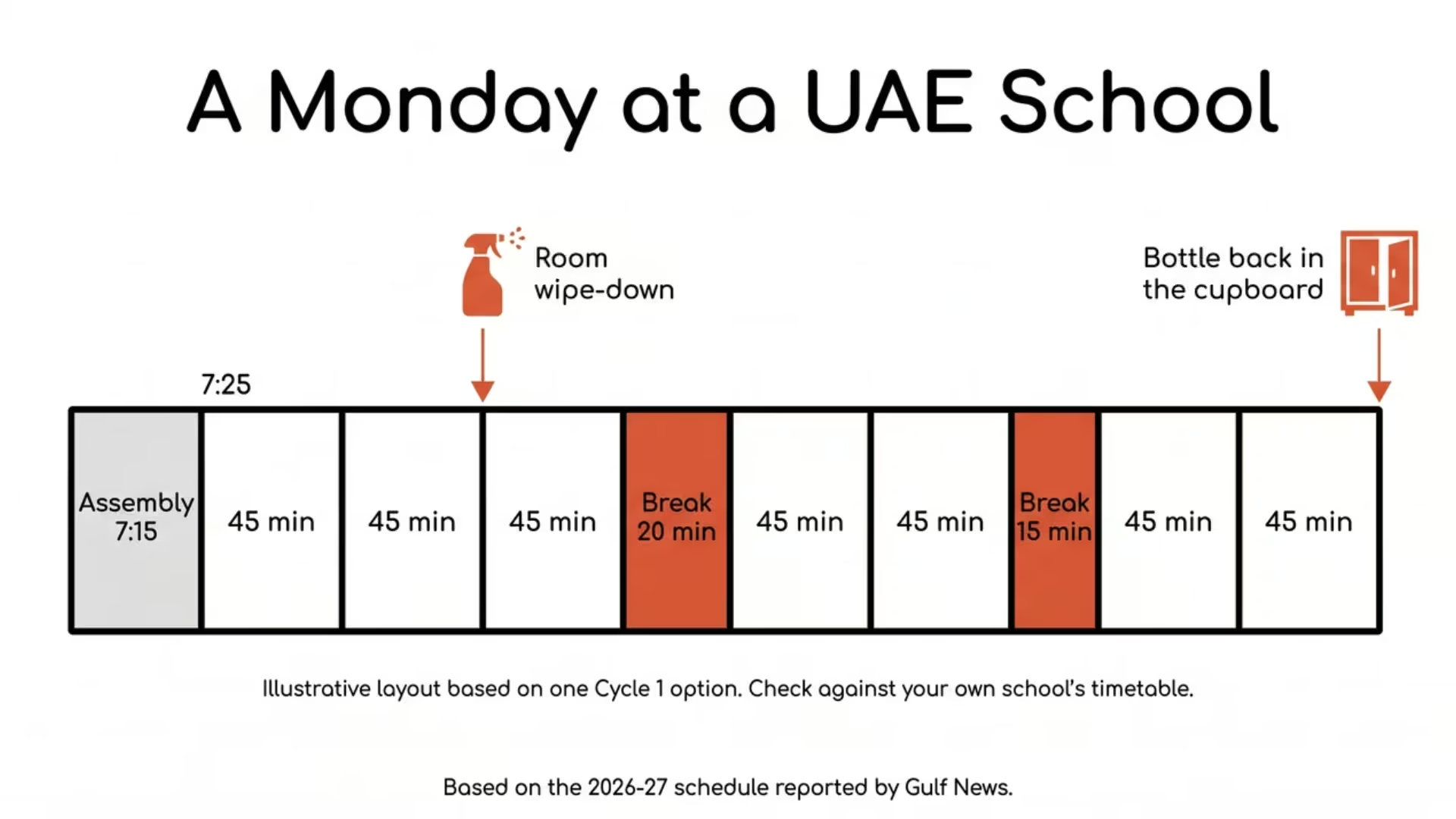
Picture a facilities manager at a UAE school on a Monday morning. Assembly starts at 7:15. The first of seven 45-minute lessons begins at 7:25, and the only breaks are one of 20 minutes and one of 15.
Somewhere in that day, rooms need cleaning. If the product on the trolley is alcohol-based,
health guidance says to keep the room ventilated and not to spray alcohol over large areas.
Later, the bottle goes back in the cupboard. The
safety data sheets (the standard safety paperwork that comes with a chemical) for 70% ethanol describe a highly flammable liquid and vapour.
None of this is dramatic. It’s fine print, sitting quietly inside a very full day.
So, do UAE schools need an alcohol-free disinfectant? Not always. But it’s worth reading the fine print before you decide.
An alcohol-free option takes the alcohol out of that picture. Whether it changes your day depends on how you clean and which product you pick.
This guide is for facilities managers and school teams in the UAE. No chemistry degree needed.
The Wait After Cleaning That Most Schools Plan Around
Start with the wipe-down at the end of a lesson. The room needs it before the next class arrives.
Alcohol evaporates quickly, so it leaves no lasting germ-killing effect on a surface. Even so, the University of Göttingen’s lab
disinfection plan asks for good ventilation of the room.
Beijing’s health authority says the same, with a warning attached. Fire can start once ethanol (the alcohol in most disinfectants) passes 3% of the air, so it advises against spraying alcohol over large areas like offices or meeting rooms. The details are in its
guidance on alcohol sterilizers.
Surfaces are the simple part. The Göttingen plan says a surface can be used again once it’s visibly dry.
So how long should a room stay empty? Your product’s label is the best place to start, and your safety officer can confirm what applies on your campus
Wondering about the air itself? HOCl Hub’s
guide on indoor air quality in UAE schools goes deeper.
What a Wait Could Cost Across a School Day?
Even a short wait matters when the timetable is this tight.
Under the 2026-27 schedule reported by Gulf News, lessons run 45 minutes from Monday to Thursday and 40 on Fridays. One Cycle 1 option has seven lessons and two breaks, of 20 and 15 minutes. Cycles 2 and 3 have eight lessons a day.
Check the full timings against your own school’s schedule.
Here’s a simple way to price a wait. Multiply your classrooms by the minutes each one sits unused, then by the school days in your term.
Try it with made-up numbers. 30 classrooms losing 10 minutes each is 300 minutes, or five hours of unused classroom time a day. Over a five-day week, that’s 25 hours.
It’s an illustration, not a measured figure. Swap in your own numbers.
Ten minutes is also more than a fifth of a 45-minute lesson. That’s what school cleaning operational efficiency in the UAE often comes down to: small minutes, multiplied.
Aqua Protego® School Pack
Curious What an Alcohol-Free Option Looks Like?
Aqua Protego® is an alcohol-free hypochlorous acid range, with a school cleaning pack listed for UAE campuses.
The Second Constraint: Disinfectant Fire Risk and Storage in Schools
The wait isn’t the only thing alcohol asks of a school. There’s also the cupboard.
Start with the safety data sheets (SDS). Those for 70% ethanol describe a highly flammable liquid and vapour, with flash points listed between 12 and 27°C .
A flash point is the temperature at which a liquid gives off enough vapour to ignite near a spark. For 70% isopropyl alcohol, one SDS lists 18.3°C and says it’s flammable near an ignition source above that temperature.
The ethanol sheet also notes that vapours may travel to a source of ignition and flash back. These sheets come from lab suppliers, so check the SDS for the product on your shelf.
Beijing’s health authority adds that alcohol should be stored away from ignition sources and out of children’s reach.
What about UAE rules? The 2017 update to the Fire Safety and Life Protection Code covers storage of flammable liquids, according to Khaleej Times.
Dubai’s new school safety handbooks also set storage rules for science lab chemicals, including ventilation and recommended temperatures. That report is about labs, so check separately what applies to cleaning products.
None of this is cause for alarm. It’s paperwork and planning. But across several campuses, the same question repeats site by site, so ask each safety officer what applies.
What an Alcohol-Free Formula Changes: Aqua Protego® in Schools?
So what changes when the alcohol isn’t in the bottle? Among alcohol-free UAE school cleaning products, Aqua Protego® is one example worth a closer look
It’s alcohol-free and bleach-free, made from water, salt (sodium chloride) and hypochlorous acid.
Hypochlorous acid, or HOCl, is a mild acid that occurs naturally in human and animal immune systems.
The formula is described as free of harsh fumes and strong chemical smells. That matters most in rooms that are in constant use. Searching for a classroom disinfectant with no fumes in the UAE? That’s the profile to look for.
It also comes in a range of sizes. Options run from a
500 ml spray cleaner and a
1000 ml disinfectant spray to a
20L bulk cleaner. All are sold through
HOCl Hub, a marketplace for HOCl products.
Storage is simpler, too. It’s non-flammable, and it needs only a cool, dark place with the cap kept on. Whether that changes your paperwork is a question for your safety officer, and HOCl Hub can be asked for the product’s SDS to take along.
Timing depends on how you use it:
- Spray and wipe: Spray liberally, leave for 30 seconds (the contact time, or how long the surface needs to stay wet), then wipe off the excess. No rinsing is needed, and no clearance time (a waiting period before people go back in) is listed for this use. .
- Fogging: Fogging (using a machine to release a fine mist of disinfectant into a room): Ventilate the area for 15 minutes before re-entry.
So the wait depends on the method, not just the product.
Aqua Protego® is also listed against three lab standards: EN 14476:2019 for viruses, BS EN 1276:2019 for bacteria, and BS EN 1650:2019 for fungi and yeast.
Documentation matters beyond the purchase, too. If your school is working toward the Green Flag, our plain-English guide to
Eco-Schools Green Flag in the UAE explains the process and what counts as evidence.
Aqua Protego® School Pack
A Safe Cleaning Solution Around Kids
Aqua Protego® is an alcohol-free hypochlorous acid range, with a school cleaning pack listed for UAE campuses.
Final Thoughts
Whether UAE schools need an alcohol-free disinfectant comes down to your own timetable, your own cupboard and your own campus. Alcohol-based products work, but they come with fresh air and careful storage attached.
An alcohol-free formula like Aqua Protego® changes what you plan around, though it still asks for ventilation after fogging. The best next step is a small one: check your current product’s label and SDS, put a number on the wait, and see what changes. If you’d like a hand, the HOCl Hub team can answer your product and documentation questions .
Frequently Asked Questions